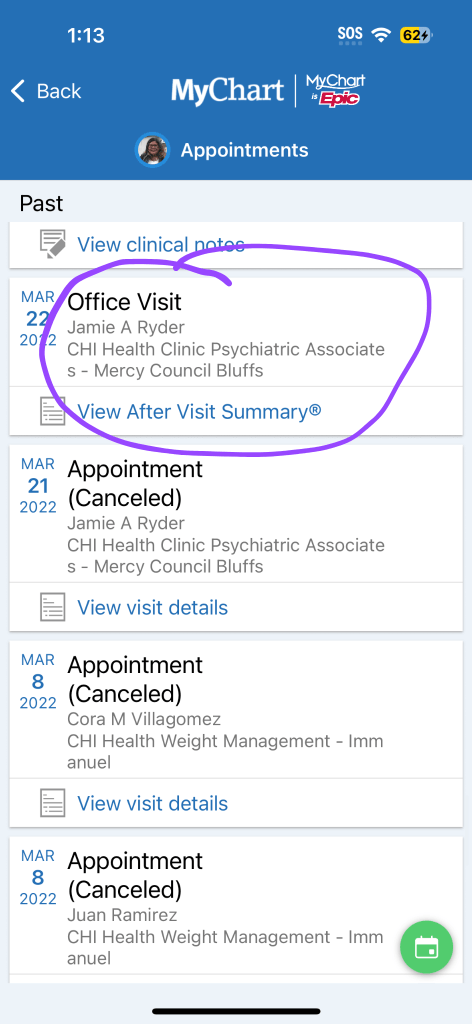
Let’s talk about bariatric surgery. Not the surgery itself, but the evaluation process, specifically that mandatory rendezvous with a very specific mental health provider. This wasn’t my regular, trusted therapist, mind you. Oh no, this had to be “the one” who focuses on food behavioral issues, the gatekeeper to my surgical clearance.
Honestly, I get annoyed having to explain my mental health history to new people. I’ve got my 2-minute elevator pitch for anxiety ready to go faster than any other kind of pitch. And when they have access to my full notes from other providers, it’s doubly frustrating to answer repetitive questions. But here, I had no choice. So, I launched into my mental health “elevator pitch.”
I explained, quite clearly, that no, I don’t have an eating disorder. I don’t “anxiety eat.” I don’t “stress eat.” There’s no emotional gorging here. I could see the wheels turning in her head, the unspoken “why are you fat then?” Seriously. I told her, “I work out. I do my best. I’ve just always been fat.”

But she deep-dived into my anxiety disorder anyway. She wanted to know how and what I do about my anxiety. Again, I had to explain: “I can’t gorge my anxiety or stress away because that’s not the problem.” The problem isn’t behavior. It’s just… my body.
The irony of this entire process was astounding. We had just realized I literally cannot eat meat – it makes me sick. Yet, for this surgery, they push you to eat copious amounts of meat because it’s supposed to make you feel fuller longer, among other things. I was getting sicker trying to meet the dietitian’s protein expectations, a dietitian who, frankly, gave off vibes of disgust working with overweight people. I got the same vibes from the therapist. Honestly, almost everyone I encountered in this process.
There was this pervasive shaming. A narrative that you’ve chosen to be overweight, and this surgery was your “salvation.” You were going to be “baptized” and emerge a new, skinny person. The new you that, as we were told in one of many orientation trainings, even promised “good odds of changing your partner.” The audacity.
So, there I was, sitting with the psychologist/therapist, genuinely puzzled. “Why am I fat? What about my behavior?” It just wasn’t clicking for them, despite my clear explanations. And then… she cleared me. Everyone else involved in the process was genuinely shocked.
Because, you see, I don’t have a behavioral or eating disorder. I was just fat.
And that’s the thing. Some people are just fat. They can’t do much to explain it. There’s no deep-seated emotional eating, no secret binges, no lack of effort. It’s just… their body.
The whole concept of tracking food? Gives me anxiety. Macros, calories, all of that? Pure dread. Reading labels? It’s a flashback to having to scan literally everything I ate. This is why I can’t in good conscience advise anyone to use any food tracking app. I know, for me, it would be anxiety-driven. If you have a Generalized Anxiety Disorder (GAD), you’re already on edge, wondering if the smell of a Cinnabon at the airport will somehow add to your calorie count. That’s a real fear, folks.
So, while I truly had nothing “wrong” mentally with my eating behaviors beforehand, I definitely have trauma over the process itself. And then, as the ultimate kicker, they also educate you on the high likelihood you may gain weight back after the surgery. So the whole experience was, in a word, torture. I wish it on no one.
Again, all I had to do was go from working out 4 times a week to a whopping 15 times (that’s hyperbole, but you get the point of the intense demand for increased activity). But now, I know where I’m at. Just move daily. And definitely, listen to your body, not the shame-filled whispers of a system that often fails to see beyond the surface.

 dghmoves.com
Leave a comment